
v2.1.0 — casual mode
Whokoban
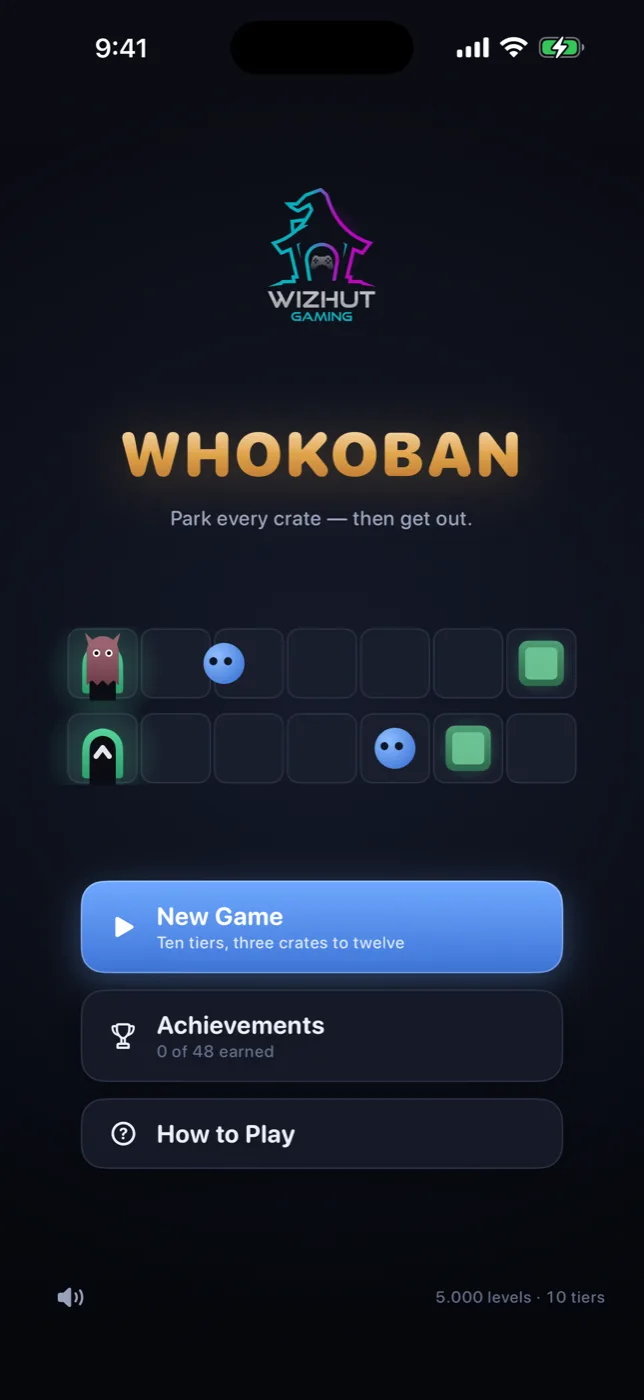
Park every crate — then get out.
Sokoban with one rule changed. Filling every goal doesn't finish the puzzle — it unlocks the exit. You still have to walk Whoko to the door, back through the warehouse you've just rearranged, where the crates you shoved into place are now the walls in your way.
- 6,090
- levels
- 26
- tiers
- 82
- achievements
iPhone · iOS 17 or later · US$2.99, one time
v2.1.0 — Casual, a new way to play: no move cap, no monsters, nothing to lose. Undo freely, skip any level and play as long as you like, with ten achievements of its own — 82 in all. And a swipe now moves Whoko from anywhere on the screen, the keys included.
Twenty seconds
One level, start to finish
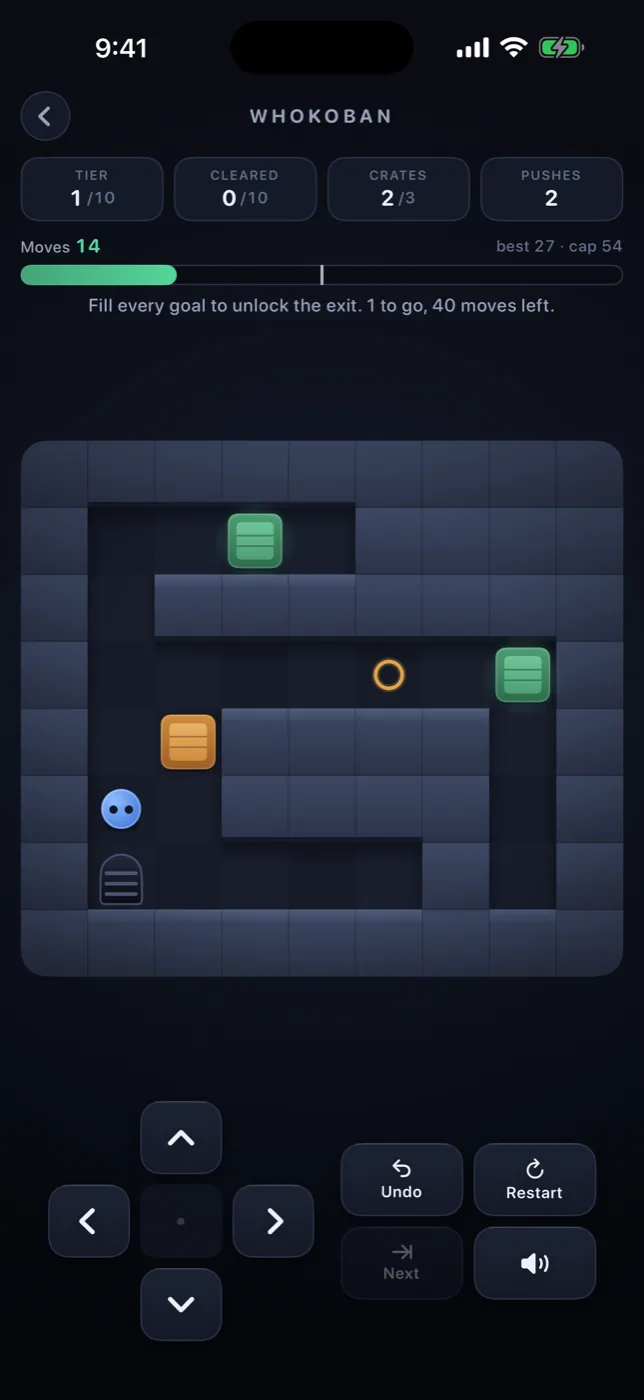
The whole loop in a tier 1 warehouse: three crates shoved into place one at a time, the exit unlocking the moment the last one lands, and Whoko walking back out through the room he has just rearranged. Nineteen moves — the best the level allows.
Fifteen looks, two of them free
Fifteen looks, one game
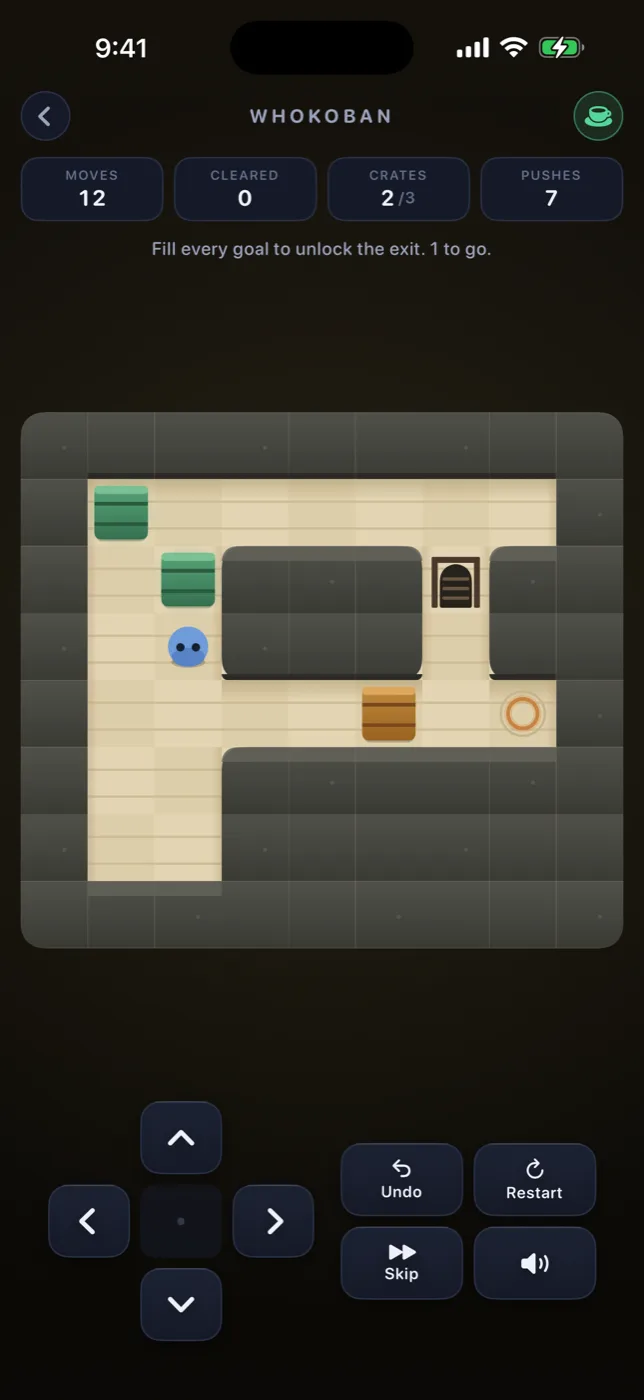
The warehouse dresses fifteen ways. Two are free: Classic, and FlyCraft — Herbie on loan from the flying-machine game, with his drawing board, his cardboard boxes and his own music. Eight are earned by climbing — neon arcade glass, a raked zen garden, brown brick and a flat grey floor, backlit stained glass — one look per tier, the last for finishing a run. Four belong to Hardcore alone: Ember, Noir, Circuit Board and Gilded, for a clear on tier 1, 4, 7 and 10 with no net. And one belongs to iPhone Duo alone: Origami, folded paper, for a clear on its inner display.
A theme changes how the board is drawn, never how it plays. Orange is still a crate to park, green is still parked, and the door still opens when the last one lands. Try them — this is the same level in every one. And Whoko blinks in every one of them now.
New in 2.1.0
Casual: nothing to lose
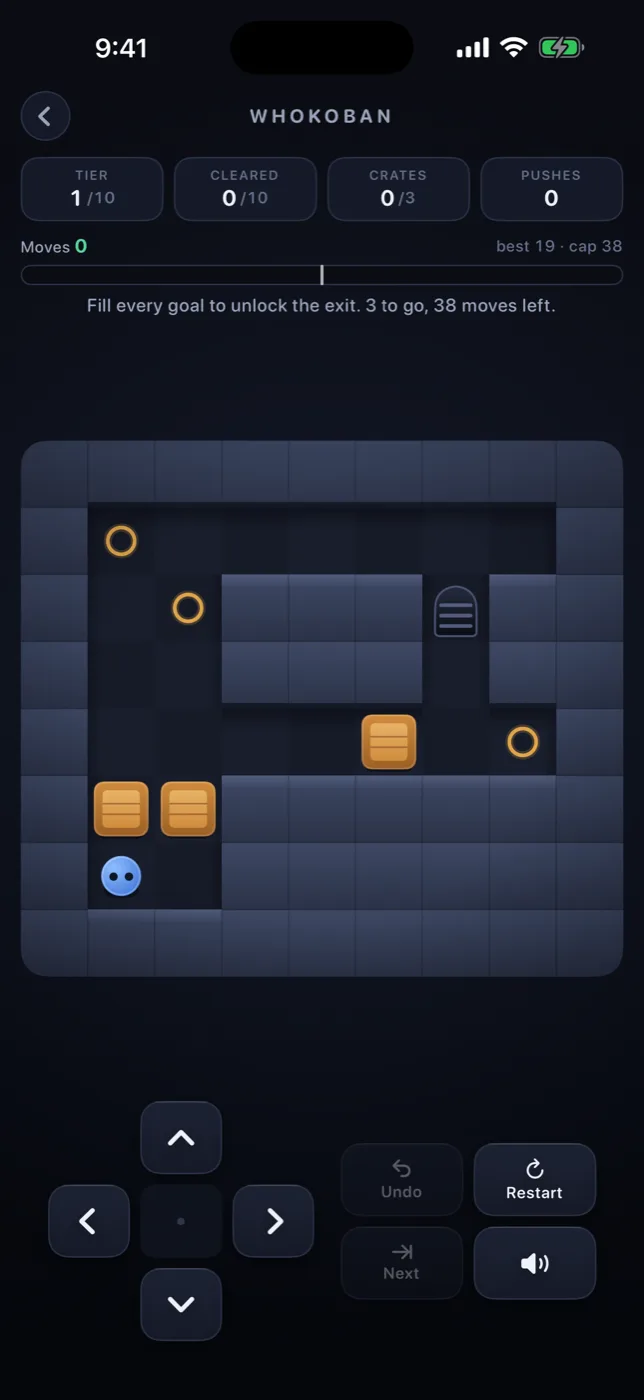
A third way to play, between Standard and Hardcore. No move cap and no monsters, so a level cannot be lost. Undo is free and goes back as far as you like, and Skip deals another level whenever you want one — from the key beside Restart, or from the card that says a board is stuck.
No tiers on screen: play a tier well and the next levels quietly come from the one above, and at the top it simply carries on. It never ends — it is over when you leave it. Ten achievements are Casual's own, one for every ten levels you clear in it, from Kettle On to Bottomless Cup.
iPhone Duo
Made for iPhone Duo
Shut, it is the phone game. Open, the board takes the room the inner display adds — about 1.7 times the size a phone gives it — with the keys and readouts beside or below it, and every picker and page laid out for a screen that is wide both ways. Turn it, and the board sits beside a column of keys.
The Great Halls of Whoko are the levels made for that screen: a thousand of them, the classic game in halls half again as big — 100 a tier across ten tiers, same monsters, same cap, every one verified and measured. Unfold the phone and they are what a new game deals; on any phone, the level count on the title screen switches between all three sets. And one look is the Duo's alone: Origami, folded paper, earned by a clear on the inner display and nowhere else.
The Lost Levels
The Lost Levels of Xsoko
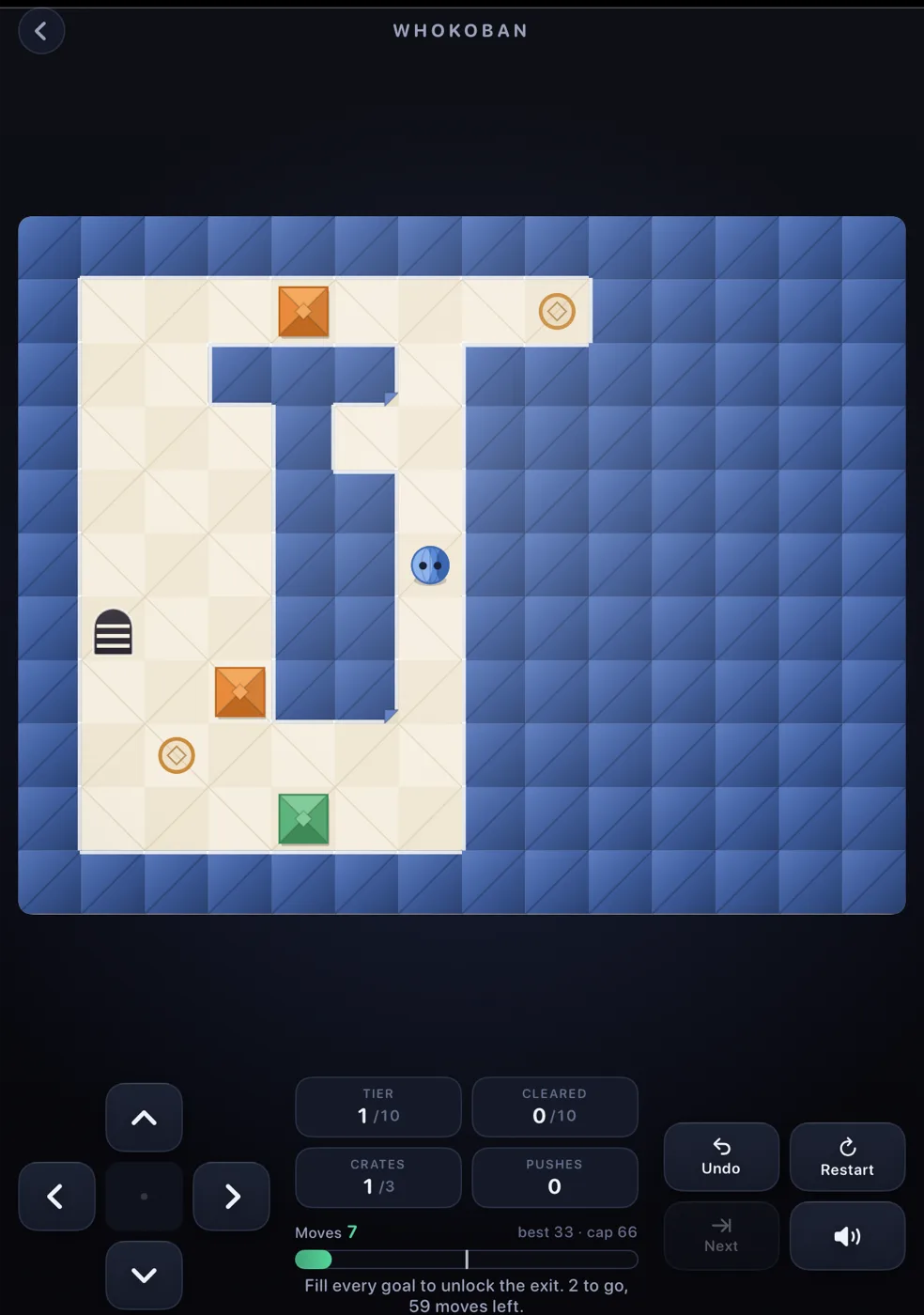
A second set of levels, and they do not play like the first. Ninety hand-measured boards in six tiers — built backwards out of their solved state rather than generated forwards, which makes them about three times denser in pushes per crate. Closer to the classic warehouse puzzles the genre is named for.
You meet them in order rather than at random: they are sorted by measured difficulty, and the curve is the point. No monsters, and no move cap — they are long by design, and a clock would turn a thinking game into a race it was never shaped for.
FlyCraft
Herbie drops in from FlyCraft
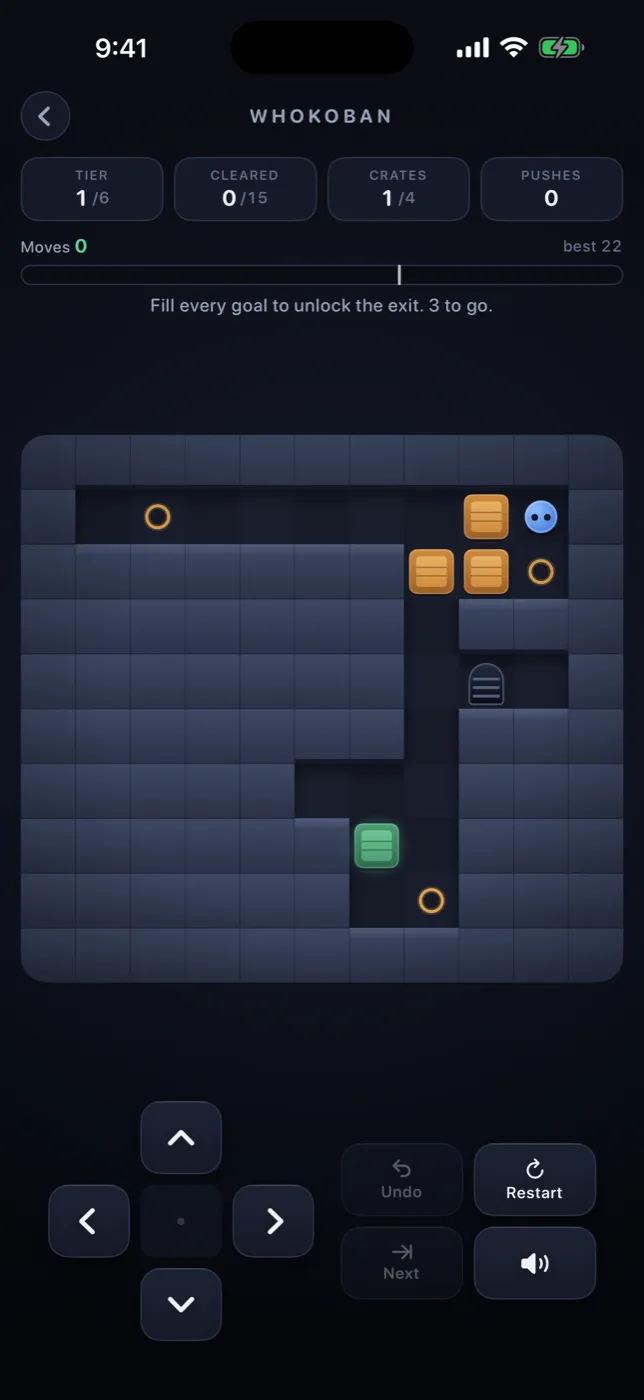
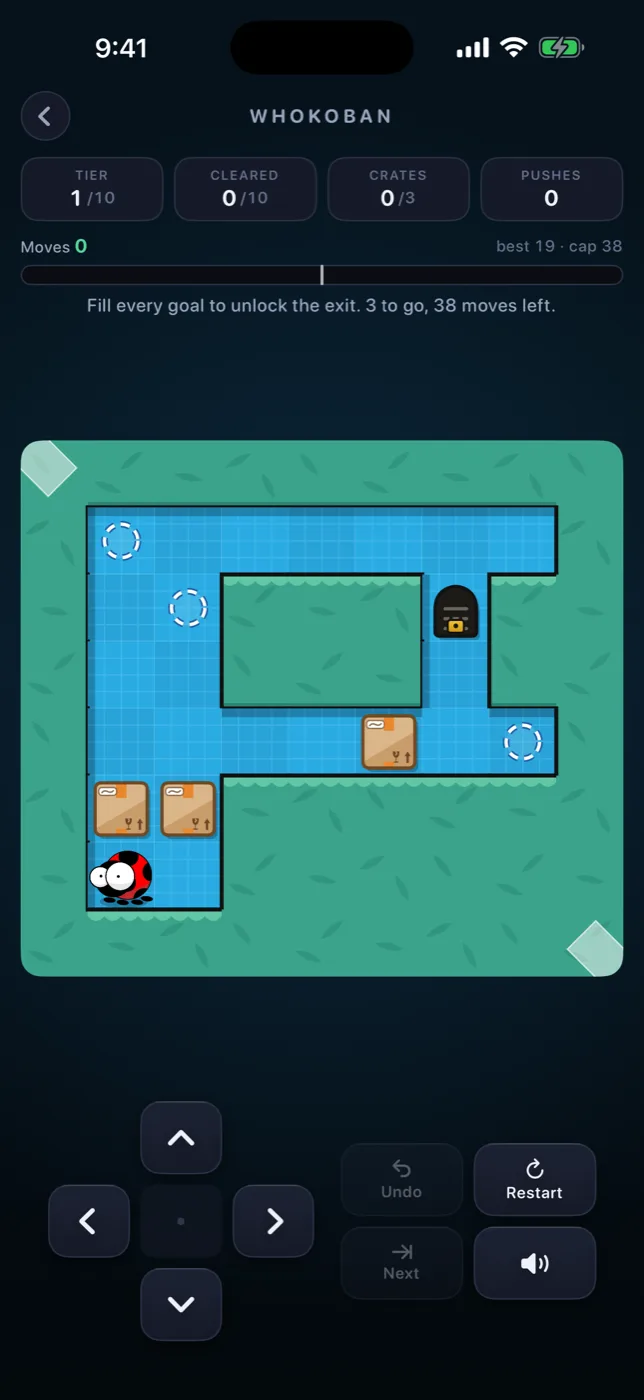
A guest from another game. Herbie — FlyCraft's hero, who would rather build a flying machine than fly — arrives as a free look for everyone: his blue drawing board for a floor, a paper-cutout forest for walls, his cardboard boxes for crates, the launch gate with a padlock on it, and Herbie himself in Whoko's place, blinking. He brings his own music, and his yell opens every run in place of the gong.
From our friends at Sentry Brain
Meet FlyCraft, the game Herbie came from
FlyCraft is a physics toy about building flying machines for Herbie, who would rather be carried than fly. The machine takes shape on the drawing board, Herbie climbs on top, and you find out how far it gets before it comes apart. By Thanasis Lightbridge and Harry Kalogirou, published by Sentry Brain.
Free to play, with one optional unlock. Whokoban's FlyCraft look — his boxes, his tunes, his yell — is on loan with FlyCraft's permission, so if the look made you curious, this is where Herbie lives.
Free, one optional unlock · iPhone, iPad and Android · in the browser too
Hardcore
Hardcore: one mistake and the run is over
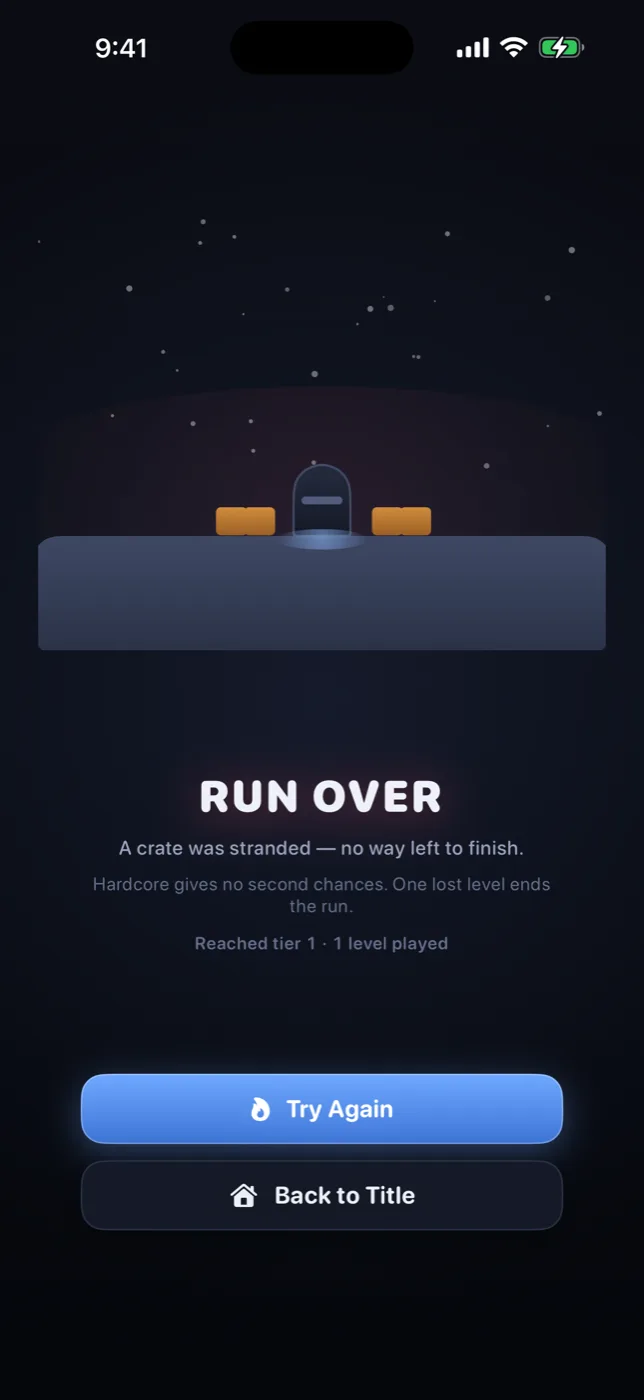
Pick a mode when you start a run. Hardcore has no undo and no restart, and one lost level — a crate stranded, or the move cap reached — ends the whole run. The board wears a flame so you never forget which game you are in.
Same levels, same tiers, same cap; only the safety net is gone. Four achievements and four looks are earned nowhere else — and losing gets its own screen, with the door shut and Whoko still inside.
The rule
Parking the crates only unlocks the door
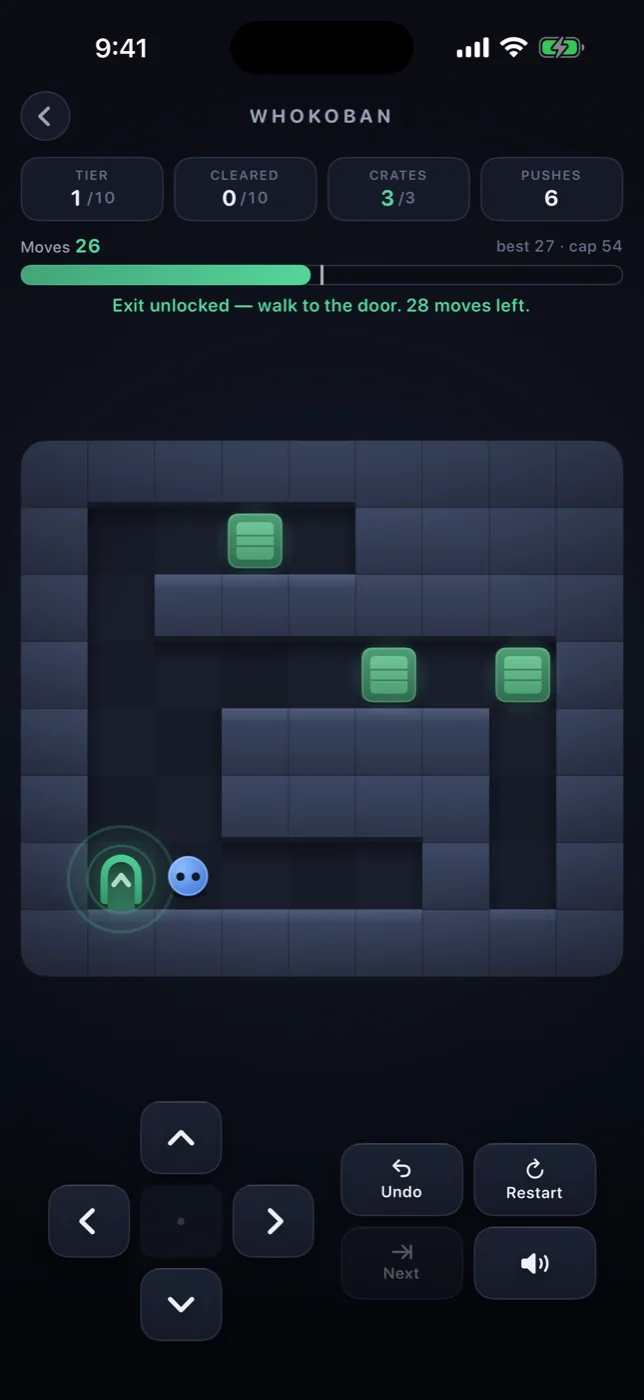
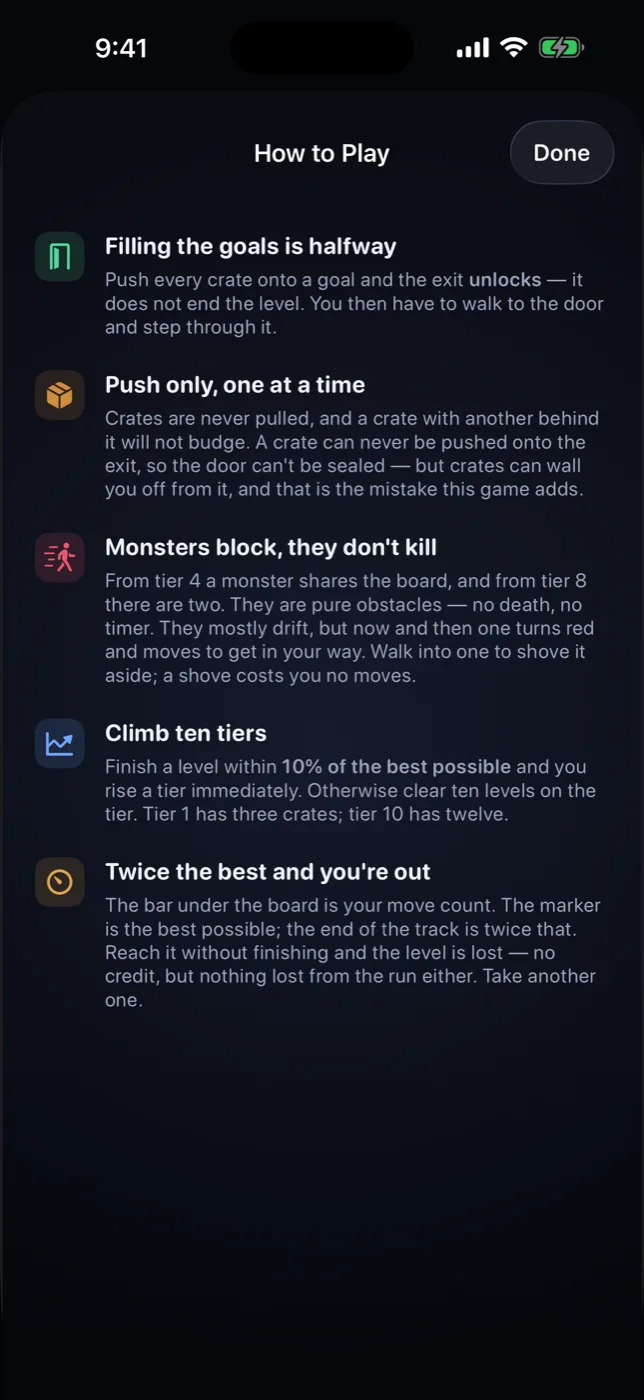
Push every crate onto a goal and the exit unlocks — it does not end the level. You still have to walk Whoko to the door and step through it, back across a warehouse you have just rearranged.
A crate can never be pushed onto the exit, so the door cannot be sealed. But crates can wall you off from it, and that is the mistake this game adds.
Par
Measured, not estimated
Every level ships with the exact fewest moves it can be finished in — walking to the door included — computed by an exhaustive solver before release. That number is what you play against.
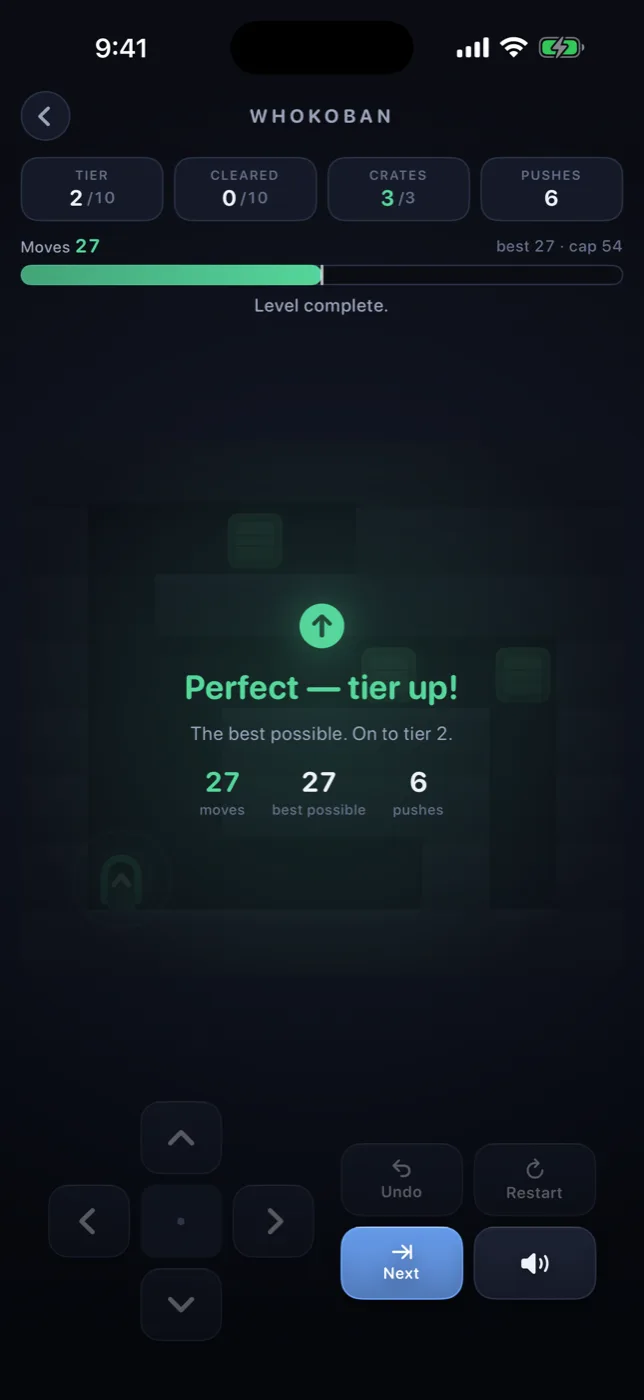
Finish within 10% of it and you rise a tier on the spot. The end of the bar is twice it: reach that without getting out and the level is over — no credit, and nothing lost from the run either.
The classic levels
Ten tiers, and no level twice
500 levels a tier: three crates at tier 1, twelve at tier 10. The game remembers which ones it has dealt you, so a level comes round again only after you have played the other 499 on its tier.
From tier 4 a monster shares the floor with you, and from tier 8 there are two. They cannot kill you — no timer, no death, no lost run. They are in your way. Walk into one and you shove it aside — for one move, like a step.
Achievements
Eighty-two of them, and one you will earn by accident
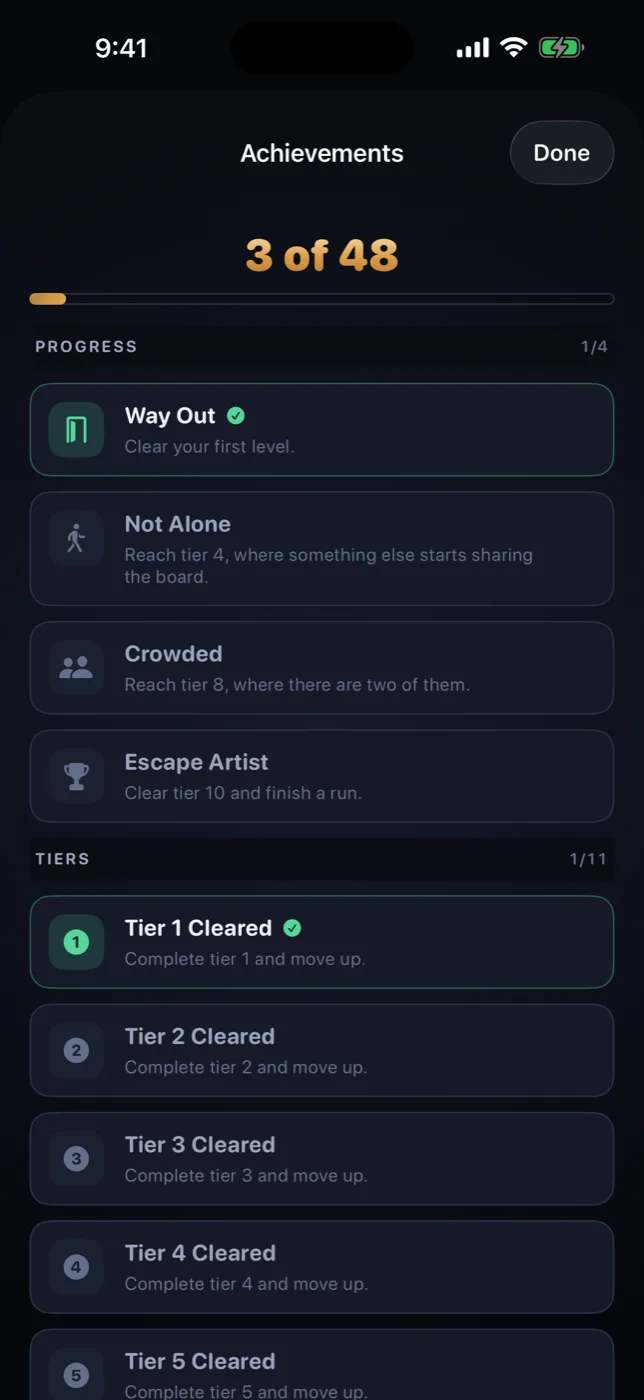
For finishing at the best possible, for finishing in the fewest possible pushes — a different skill, and the one the Lost Levels are built to test — for clearing whole tiers, for a run from tier 1 to tier 10 without a single undo, for a level in every look the game owns, for a first clear and a whole run in the Great Halls, for a hundred levels of Casual, and for surviving Hardcore, with a secret one for not surviving it.
And for the mistake this game invents: parking every crate with no way left to reach the door. A card lands over the board the moment that happens, with the two ways back on it — and an undo now costs a move of its own, so the way back is never free.
Nothing leaves your phone
No ads. No in-app purchases. No account.
There is no network code in the game at all, nothing is tracked and nothing is collected. Every level is rebuilt on your phone from a seed rather than downloaded — so all 6,090 of them work with no signal.
iPhone · iOS 17 or later · US$2.99 once · no ads, no in-app purchases, nothing tracked