
19 November 2026 · 6 min read
Park in seven pushes: Whokoban gets puzzles
A chess puzzle is a small thing. The pieces are already on the board, somebody has played the opening and the middle game for you, and there is one line under the diagram; white to play, mate in three. You do not play a game, you solve a moment of one. Newspapers have printed them for longer than any of us has been alive, and they still work for the same reason; the answer exists, it is exact, and it is short.
Whokoban has its own version of that now. A puzzle sets the crates and says park in seven; every crate on a goal and Whoko out of the door, in seven pushes, and seven is the fewest there are. Thirty of them are free to play in the browser, on the puzzles page. The game for iPhone gets 150 more of its own in version 2.6.
Mate in three, park in seven
There are four rules, and most of them are about what counts.
- Pushes count, steps do not. Walk anywhere you can reach, for free. Counting steps would reward a tidy route, which is not the interesting part; a crate in the wrong square is what loses a Sokoban puzzle, as a piece in the wrong square loses a chess one.
- The number has no slack. N is the fewest pushes the position can be finished in. There is no par to beat (and no bonus for beating it); you find the line or you do not.
- A losing push loses at once. A push that leaves no way to finish within the pushes left ends the puzzle there, instead of letting you shuffle crates for another ten minutes on a position that was already lost.
- The door still matters. As in the game, parking the last crate only opens the door, and the crates you just parked may stand between Whoko and the way out.
The key
Chess problem composers have a word for the first move of the solution; they call it the key, and a sound problem has exactly one. A problem with a second solution is broken, and they have a word for that too (it is cooked). That was the standard I wanted, and it raises an awkward question. How do you make a Sokoban position with exactly one key?
Searching forwards from a random position is hopeless; you do not know where the solution is, or whether there is one. So the puzzles are made the other way round. Each one starts at the finish of a real Whokoban level, every crate parked, and the tools walk it backwards, push by push, eighteen at most. Walking back from the finish gives every position on the way an exact figure, the fewest pushes it takes to get there again. Then each candidate is measured as a puzzle, and kept only if exactly one first push keeps that figure and at least two sensible first pushes lose it.
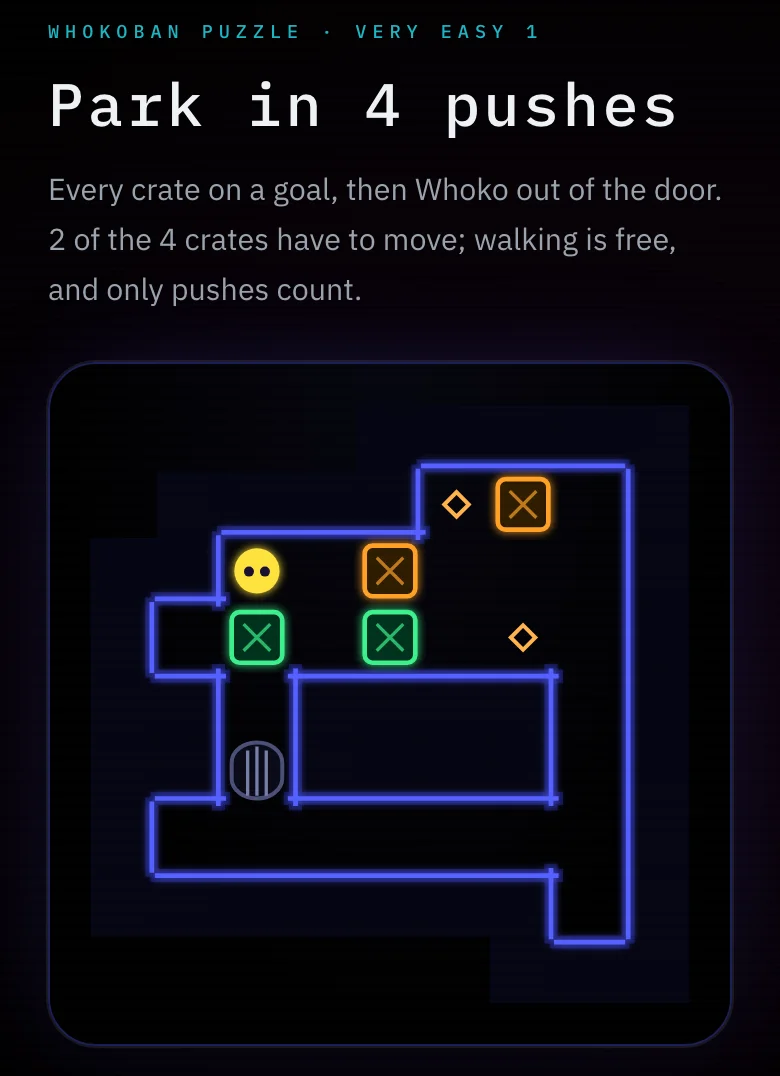
One consequence surprises people the first time. Very easy 1 has four crates on the board and asks for four pushes, but only two of the crates have to move; the other two are parked already, and part of the puzzle is seeing that they can stay where they are. Across the thirty in the browser the boards hold between four and twelve crates, and the puzzles ask for between four and eighteen pushes.
Lost on the spot
The rule that a losing push loses at once is easy to write down and harder to keep. After every push the game has to answer one question; can this position still be finished in the pushes left? It answers by searching, breadth first, every position reachable within that many pushes (squares from which a crate can never reach a goal are left out of it). A search like that can grow very large, so it has a budget of 20,000 positions, and a search that runs out of budget says nothing at all. In a puzzle, saying nothing means you keep playing a position that is already lost, which is exactly what the rule promises will not happen.
So the budget is not hoped for, it is proved. Before a puzzle is accepted, the same search runs on every position of every winning line, and on every push a player can make from each of them (off the winning lines the puzzle is already over, so those are all the questions the game will ever ask). A puzzle with a single answer that needs more than 20,000 positions is refused. The worst of the thirty in the browser needs 16,627.
You focus mostly on one box
The first set was graded by luck. For every puzzle the tools measured how likely a random player, nudged towards the goals, was to stumble on the solution, and the less likely, the harder the grade. It looked reasonable on paper. Then I played them. The easy ones were very easy, the hard ones were not hard, and the verdict fitted in one line; you focus mostly on one box. A puzzle that drives one crate through a corridor of parked ones is a maze, and a maze is not hard the way a chess puzzle is hard.
So the grade now counts what the solution has to move. Very easy moves two crates, Easy three, Medium four, Hard five and Very hard six or more, and the solution has to switch between crates at least as often as it has crates to move. That is where the difficulty is; holding five crates in your head, and the order they have to go in.
Thirty in the browser, 150 in the app
The two sets do not overlap. None of the thirty in the browser comes from a level the app's puzzles use, so playing one tells you nothing about the other. The browser has six a grade, and in four of the five grades one of the six is a door puzzle.
- In the browser, the keyboard is the control (arrows or WASD to walk and push, U to undo, R to restart, H for Show me), and swipes on a phone. The game's band plays a new tune for every puzzle and speeds up as the pushes run out. What you have solved is kept in your own browser, and a solve without Undo, Restart or Show me counts as clean.
- In the app, 150 puzzles, thirty a grade, with Show me, a star for a clean solve, a Continue of their own on the title screen, and eight achievements, the last of them for solving all 150 clean. They come with Whokoban 2.6, which is not on the App Store yet.
Epilogue
Ok, a puzzle is a smaller thing than a level. There is no climb, no monster and no run to lose; you sit down, solve one, and get up. That is the point of the format, and probably the reason chess puzzles have outlived most of the games printed next to them.
A chess puzzle tells you there is a mate in three. It never promises that you will find it, and neither does Whokoban. Show me is always there for that; it only costs you the clean solve.