
14 November 2026 · 5 min read
Whokoban 2.5: it remembers where you left off
Whokoban 2.5 is out, and the first thing in it fixes the oldest complaint about the game. You climb to tier 7, a call comes in, you switch apps for a while, and iOS decides it needs the memory more than you need your run. Continue was there on the title screen to protect exactly that run; it protected it only for as long as the app stayed alive.
There are three changes in this version, and they have nothing to do with each other; the saved game, the music, and the seasons. I will take them in that order.
Save early, save often
Saving a game is not a new idea (the NES cartridge of The Legend of Zelda carried a battery for it in 1987 :) ). The interesting part is not the saving, it is what you write down. A copy of the app's memory would have been the lazy option, and it breaks on the first update. So Whokoban writes a description of the position instead, small enough to read by eye.
- The run; the mode, the set of levels, the tier and how many levels you have cleared.
- The level, by its set, its tier and its number. Every level is rebuilt from a seed, so a number is all it takes to build the same board again.
- The board; where every crate and monster stands (the monsters' mood included), your moves and pushes, the undo you are still owed, and the end-of-level card, if you had not dismissed it yet.
It is written when a level starts and ends, when you go back to the title, whenever the app leaves the screen, and one second after your last move. iOS always sends an app to the background before you can swipe it away, so closing it by force is covered; a crash costs you one second of play, at most. There is one save, the last game. New Game replaces it, and a lost Hardcore run deletes it, because there is nothing left in it to continue.
Strike up the band
The music was a reel of forty chiptune variations, a triangle wave carrying the tune over a square-wave bass. It did its job under a puzzle, but after a few hundred levels it wore thin. So 2.5 replaces it with a band; accordion, trumpet, clarinet, tuba, banjo and glockenspiel.
The catch is that Whokoban ships no audio files (it never did), and I did not want to start now. Every note is played by a small synthesizer inside the game. So an instrument here is a recipe rather than a recording; an accordion is three reeds a few cents apart that take thirty milliseconds to speak, a trumpet scoops up into its note and shakes once it has landed, a banjo is a plucked string that goes dull a tenth of a second in. The same synthesizer, ported line for line to the browser, plays all thirty-six tunes on the soundtrack page.
- On the title screen, Crate Polka, the house tune.
- In the levels, one of Dockside Rush, Forklift Waltz, Pallet Jack and Clipboard Rag, at random and never the same one twice in a row.
- In the FlyCraft look, Herbie's Flight, a tune of his own.
- In each season, if you switch the seasons on (more on that below), a polka in the season's dress on the title and four tunes of its own in the levels.
The music still knows how you are doing. As you close in on the move cap the tempo creeps up by about 16% and layers come in one at a time; a woodblock ticking like a kitchen clock, a tambourine, a sour twin of the tune, a grating drone, and a low pulse for the last stretch. The tension follows the actual danger, not a switch that flips once. And a step now makes a small whoosh, in key with the band, instead of a dry tick.
The Four Seasons
Whokoban has had seasons since 2.2; windows in the year, each with a look for the board and an award you can only earn while it is on. They left gaps, though. Mid-November belonged to no season at all, and the title screen kept wearing Halloween's bats for two weeks after Halloween, pointing at an award nobody could earn any more.
In 2.5 autumn, winter, spring and summer fill every day that Halloween and Christmas do not. Autumn runs from 15 September to 14 December and steps aside for Halloween, winter from 7 January to 19 March, spring to 20 June and summer to 14 September. On any day exactly one season is on, so there is always a seasonal look to earn.
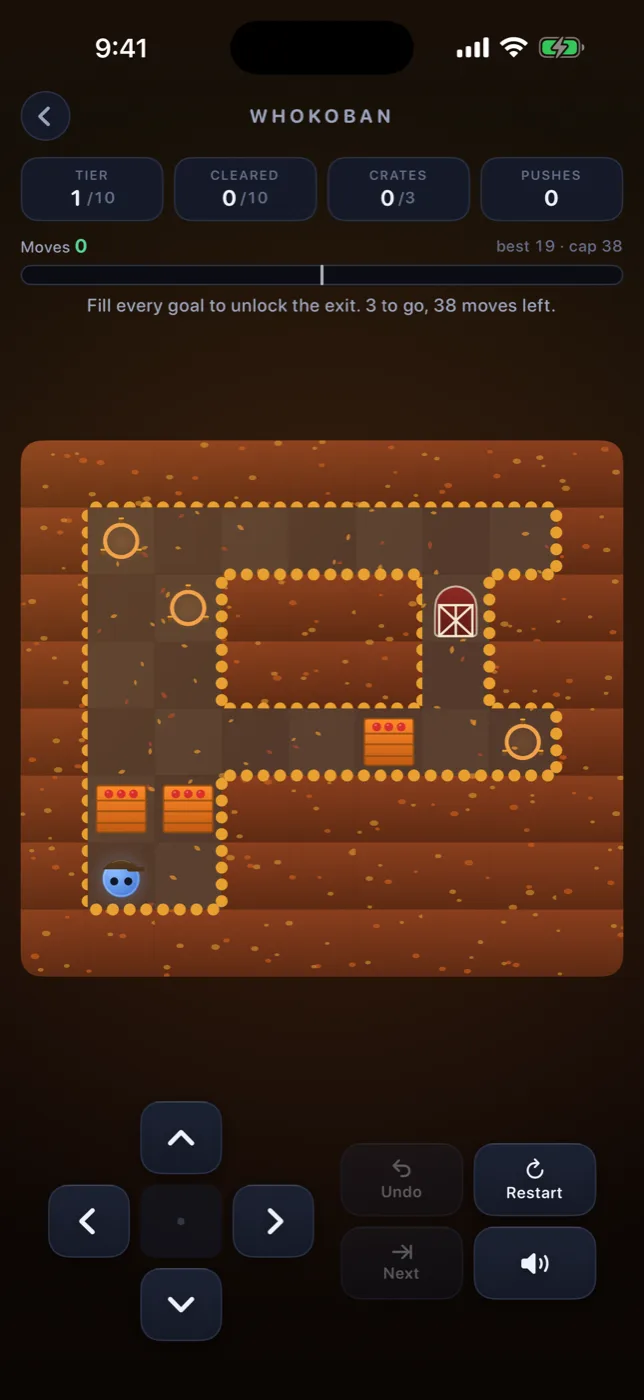
The other half of the change is a matter of taste, and I will defend it. The season on the title screen (its colours, its weather and its music, in the levels too) and the seasonal app icon are now off until you switch them on, in the theme picker. A season in a game is a nice touch; a season you cannot turn off is decoration you did not ask for, and an icon that changes on its own comes with an iOS alert that nobody can suppress. The looks themselves still come and go with the calendar, and you still earn them the same way.
Epilogue
The update is free, as always; no ads, no in-app purchases, and nothing tracked (the game has no network code at all). If you want to hear the band before you play, the soundtrack page plays every tune in the browser.
None of this makes the puzzles any easier. You still have to park every crate and then get out; the game just remembers where you were when life interrupted.